With the TintoAI method, your documents stay in your company and every answer is verified against its source
With the TintoAI method, a company's documents stay inside it when it uses artificial intelligence: in an account in its own name or on its own servers, and out of the training of any outside model. Every answer arrives with the document, the clause and the cut-off date in view, and its origin is verified as it is read.
How do I verify that the answer came from a real document?
Does the fixed price in the contract with Supplier X cover reference C? I need it with its source for the procurement committee.
Yes. Under the contract with Supplier X, signed on 12 March 2026 and in force until March 2027, the fixed-price clause applies to references A, B and C.
Source: contract PX-2026-04, clause 7.2 · Procurement · Marcela Ríos · verified on 28 July 2026
| What you read | What you do |
|---|---|
| «The fixed-price clause applies to references A, B and C» | You compare it with the text of the clause |
| «Source: contract PX-2026-04, clause 7.2» | You open that contract at that clause |
| «Signed on 12 March 2026» | You know the date of the document |
| «In force until March 2027» | You know how long you can rely on it |
| «Verified on 28 July 2026» | You know when it was last checked |
What discount did we give Distribuidora Andina at the last renewal, and who approved it?
8% off the 2026 price list, approved by the Sales Director at the committee of 3 February 2026, valid until 31 December 2026.
Source: sales committee minutes CC-2026-02, item 4 · Sales · Andrés Pardo · verified on 15 September 2026
| What you read | What you do |
|---|---|
| «8% off the 2026 price list» | You compare it with item 4 of the minutes |
| «Source: minutes CC-2026-02, item 4» | You open those minutes at that item |
| «Approved on 3 February 2026» | You know the date of the decision |
| «Valid until 31 December 2026» | You know how long it applies |
| «Verified on 15 September 2026» | You know when it was last checked |
Does the confidentiality clause proposed by Cliente Norte match our standard?
Partly. Our standard sets confidentiality at five years after the contract ends, and Cliente Norte's proposal sets it at two. The rest of the text matches the current version.
Source: non-disclosure agreement template JUR-EST-03, version 4 of 10 January 2026, clause 6 · Legal · Catalina Mejía · verified on 2 September 2026
| What you read | What you do |
|---|---|
| «Five years after the contract ends» | You compare it with clause 6 of the standard |
| «Source: template JUR-EST-03, clause 6» | You open that template at that clause |
| «Version 4 of 10 January 2026» | You know you are comparing against the version in force today |
| «Verified on 2 September 2026» | You know when it was last checked |
What is the agreed delivery time for order 4471 from Ferretería El Roble?
Twelve business days from payment confirmation, under the purchase order accepted on 19 August 2026. Payment was confirmed on 24 August, so delivery is due on 9 September 2026.
Source: purchase order OC-4471, delivery terms, section 3 · Operations · Julián Castro · verified on 25 August 2026
| What you read | What you do |
|---|---|
| «Twelve business days from payment confirmation» | You compare it with section 3 of the order |
| «Source: purchase order OC-4471, section 3» | You open that order at that section |
| «Accepted on 19 August 2026» | You know the date of the document |
| «Payment confirmed on 24 August» | You know when the deadline starts to run |
| «Verified on 25 August 2026» | You know when it was last checked |
It is verified by opening the document the answer cites, at the clause it points to, and comparing. Every answer arrives this way, and comparing takes seconds: that is why it is done with all of them.
Every answer also carries the date of the document it comes from. If that date is already far behind, the answer arrives with an automatic warning: the source may no longer be current, and it is worth confirming it with whoever maintains it before deciding.
Getting a document into a state where it can answer is TintoAI's work, and most of the project. You receive the result: an answer you check by opening a file.
And when the source has aged, the warning arrives with the answer: «The discount policy that answers this question has a cut-off date of January 2025 and has gone 18 months without review. It is worth confirming it with the sales director.»
Where are my documents kept?
Inside your company, in one of that you choose before starting: an account in your name with the artificial intelligence service, or your own servers. In both, TintoAI builds inside and the information stays within your domain.
When the work with TintoAI ends, everything is already where it should be: the account or the machines were yours from day one, and withdrawing access is all it takes. Which of the two suits you depends on the information that will go in, and that is the next question.
| In an account in your name | On your own servers | |
|---|---|---|
| Where the documents are kept | In the subscription your company takes out with the artificial intelligence provider | On the machines or cloud your company already manages |
| Who owns it | Your company: the contract and the account are in its name | Your company: the machine is its own |
| What TintoAI does | Builds and maintains inside that account, with the access you give it | Builds inside your infrastructure, with the access your technology team gives it |
| What your company needs | To take out the account | A technology team to support it |
| Who it suits | Most mid-sized companies. It is the one proposed by default | Companies with strict security policies. It takes longer |
Is it safe to upload confidential information to an artificial intelligence?
It is safe when each kind of information works in the place that belongs to it. Before anything is uploaded, your company's information is classified into : public and internal information work in the account in your name; confidential information, on your own servers or anonymized. The classification is written before the first line of code and posted on the intranet.
| What it includes | Where it works | |
|---|---|---|
| Public | Public information, marketing material, standards and third-party texts already published | Any tool your company approves, including general-purpose ones |
| Internal | Procedures, templates and aggregated analyses, free of personal data and trade secrets | The account in your name, with retention and training switched off: your conversations stay out of the provider's storage and training |
| Confidential | Personal data, payroll, medical records, trade secrets and third-party information under confidentiality | Your own servers, or anonymized, under a data processing agreement |
External Circular 002 of 21 August 2024, issued by Colombia's Superintendence of Industry and Commerce (SIC), set guidelines on the processing of personal data in artificial intelligence systems. Whoever documents their use from now on will be ahead on the day it is required.
How do I protect my clients' confidentiality?
By treating your clients' information as what it is: borrowed. You hold it under an agreement you signed and you answer for it, so, beyond classifying it, it is backed by .
And something we say before you ask: every decision that affects a person —a hiring, a performance review, a loan, a price for a client— is signed by a person.
| What happens to your clients' information | What backs it | |
|---|---|---|
| The Confidential level | It works only on your own servers, or anonymized | The classification, written before the first line of code |
| Access set at the source | Each person sees the material that corresponds to their access level | The permissions defined by the owner of each area |
| Out of training | It stays out of the training of any model outside your company | A signed confidentiality agreement, which prevents it from being shared or used in third-party projects |
Which tasks are worth handing to artificial intelligence, and which should stay in human hands?
How invoicing an order is divided up
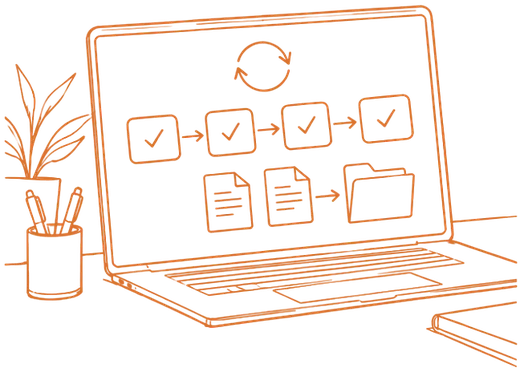
Two competent people always produce the same result, and that result is checked against an objective source.
- Match the invoice against the purchase order
- Calculate taxes and withholdings
- Update the client database
- Put together the document package
Runs on its own
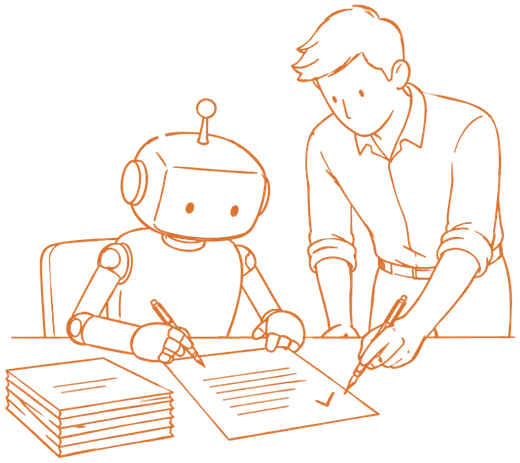
It requires judgement, and that judgement can be written as rules that someone else would apply the same way.
- Classify a client complaint
- Draft the technical response
- Summarize the contract for the committee
AI does it, the expert reviews
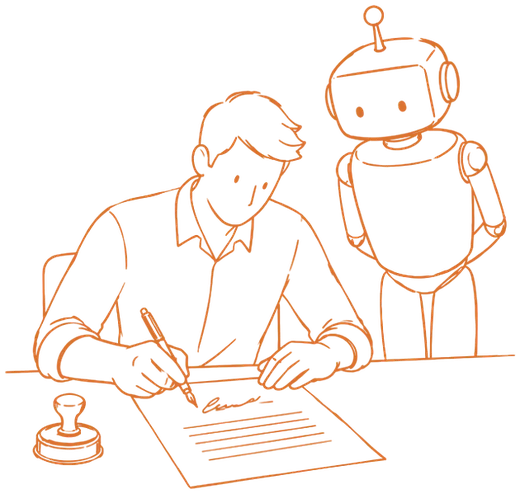
One of four is enough: someone answers with their name to a client, a bank or an authority · it commits money or reputation above a threshold · the error is irreversible · it requires reading a person.
Annex to the contract · Steps that are never automated
- Approve a discount outside policy
- Sign the response to an authority
- Accept a new clause
- Decide who is hired
Never automated
It is worth handing to artificial intelligence whatever can be checked against a source, and keeping in human hands everything someone signs with their name.
The fear almost nobody says out loud is a different one: that automating takes away your control over the decisions you still have to sign. Almost every proposal makes it worse by promising that «AI takes care of everything».
Here it works the other way round. Before a process is touched, its steps are divided into three layers, and the list of what is never automated is written first and goes into the contract.
| The layer | How a step is recognized | Who does it |
|---|---|---|
| Fixed rule | Two competent people always produce the same result, and that result is checked against an objective source | Automated. It runs in batches; if it fails, someone notices and runs it again |
| Repeatable judgement | It requires judgement, and that judgement can be written as rules that someone else would apply the same way | Artificial intelligence does it, with the expert's judgement written on top, and the expert reviews |
| Human decision | One of four is enough: someone answers with their name to a client, a bank or an authority · it commits money or reputation above a threshold · the error is irreversible · it requires reading a person | Never automated. The list is written before starting and goes into the contract |
The division leans generously toward the third layer: it is better to leave a step in human hands and recover it later than to automate a decision the company needed to sign. And it is done with your figures: two cycles of the process are observed, the hours are logged, and step by step the layer is decided with the process owner in the room. The instrument is TintoAI's; the numbers are your company's.
What you decide, and when
Three things are decided before the first line of code, and you decide all three: where your data lives, what goes into each level of the classification and what stays out, and which steps are never automated. All three are put in writing.
Start with the classification What a company brain builds
Or write to us at hola@tintoai.com
Page updated on .